
Help desk support services: a buyer’s decision guide

A practical guide to support intake, ticket ownership, escalation, reporting, onboarding and access controls.

Help desk support services: a buyer’s decision guide

A practical guide to support intake, ticket ownership, escalation, reporting, onboarding and access controls.

Design the request journey

Choose clear channels for incidents and service requests, then define the information needed to route them: affected user, system, business impact, urgency and safe contact details. Confirm that users receive a reference and know how to add context. Avoid asking people to send passwords or sensitive data in ordinary tickets.

Open laptop showing an abstract blue glow on a white desk next to navy headphones in a bright, blurred office

Clarify ownership and escalation

Document who owns a ticket at each stage, when it moves to a specialist, and who updates the requester. Distinguish acknowledgement, first response and resolution; they measure different events. Set escalation triggers around business impact, security concerns, blocked work and elapsed time, with an accountable receiving team.

Office desk with a monitor, a plant and a notepad, and a headset resting on an empty chair

Make reporting comparable

Define each metric before reviewing a dashboard. A ticket count, backlog age, reopen rate and time to resolution answer different questions. Segment by priority and request type, and read the figures with service hours and ticket scope in view. Use trends to find recurring causes rather than treating one number as a complete measure of quality.
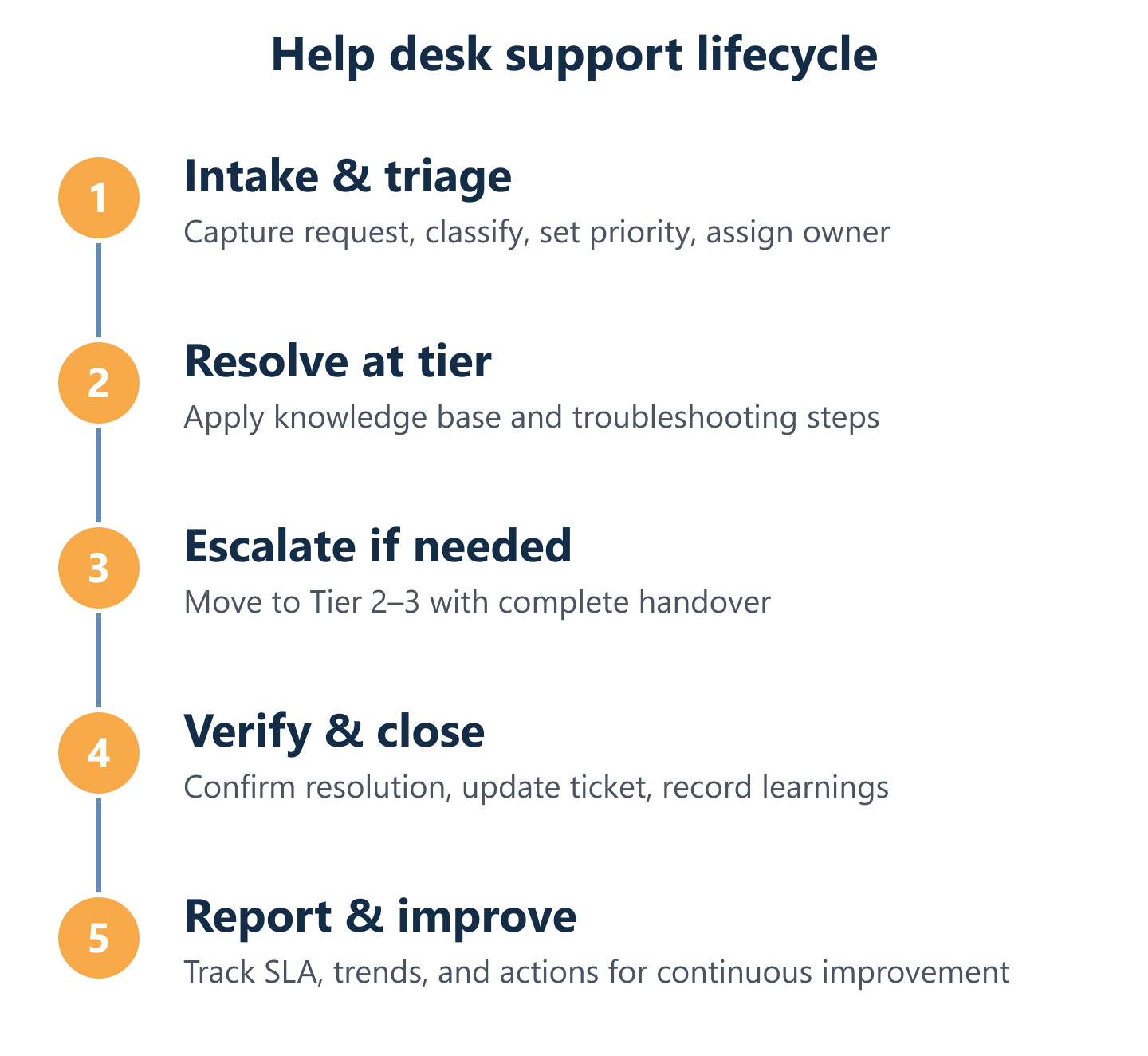
Help desk service cycle from intake to closure with escalation
Support lifecycle overview

Prepare onboarding and controls

Inventory supported users and systems, document known issues, agree access approval and removal, and test the routing path before transition. Establish a review cadence for unresolved tickets, knowledge articles and scope changes. Keep administrative credentials out of shared notes and use controlled access procedures.

Frequently asked questions

What should a support request include?
A concise description, affected service, impact, urgency, useful error details and a safe way to follow up. Do not include passwords or unnecessary personal data.
What is the difference between first response and resolution?
First response records an initial acknowledgement or action. Resolution records when the issue is considered addressed under the agreed process. Define both consistently.
When should a ticket be escalated?
Escalate when impact, security risk, specialist access or elapsed time crosses an agreed trigger, and transfer ownership with the evidence already collected.
Which help desk metrics are useful?
Backlog age, ticket volume by type, reopen rate and response or resolution times can help when definitions and scope are consistent.
How can onboarding reduce disruption?
Use an agreed inventory, knowledge transfer, access approvals, routing rehearsal, named owners and a process for open issues.

Let’s talk about your IT.

Tell us what your team needs today and what you would like to improve.