
IT infrastructure management services cover the monitoring, maintenance, security and lifecycle management of an organisation's technology environment—spanning servers, operating systems, storage, networks and cloud workloads—under defined SLAs to ensure availability, performance and continuity.
Most IT failures do not happen without warning. They happen when patching cycles slip, monitoring gaps go unnoticed or backup procedures are never tested. Organisations that rely on reactive support end up spending more time recovering from incidents than preventing them—and the operational cost compounds quickly across lost productivity, compliance exposure and emergency vendor fees.
What IT Infrastructure Management Services Include (On-Prem, Cloud, Hybrid)
The distinction between on-premises, cloud and hybrid delivery matters because each model carries different management responsibilities. On-premises environments demand hands-on maintenance cycles, physical access and direct hardware oversight. Cloud environments shift some of that burden to the provider but introduce governance, access control and cost visibility challenges. Hybrid environments—the most common scenario today—require consistent management practices across both, which is where many organisations struggle without a dedicated partner.| Environment Type | Primary Management Focus | Key Risks Without Managed Support | Typical SLA Priority |
|---|---|---|---|
| On-Premises | Hardware lifecycle, OS patching, local backup, physical network | Hardware failure, unpatched vulnerabilities, manual backup gaps | Response time + uptime guarantee |
| Cloud (Azure / M365) | Identity management, licence governance, workload performance, cloud backup | Cost overruns, misconfigured access, data loss without cloud-native backup | Availability + change management |
| Hybrid | Unified monitoring, consistent patching, cross-environment DR, security policy alignment | Visibility gaps, inconsistent controls, complex incident triage | End-to-end visibility + escalation clarity |
Core infrastructure components: servers, OS, storage and network
The foundation of any infrastructure management engagement covers four interdependent layers: physical or virtual servers, operating systems, storage systems and network infrastructure. Each requires its own maintenance discipline—server hardware demands firmware updates and capacity planning; operating systems need structured patching cycles to close security vulnerabilities without disrupting workloads; storage requires monitoring for capacity thresholds and integrity checks; and network infrastructure needs performance baselines, fault detection and configuration management.Cloud and internet tooling: governance, access and workload operations
Cloud environments introduce a distinct set of management responsibilities that on-premises tooling alone cannot address. Governance frameworks must define who can provision resources, how costs are tracked and what data can reside where—particularly relevant under GDPR. Identity and access management becomes critical: without proper controls, cloud workloads are exposed to credential-based attacks that bypass perimeter defences entirely.Operational processes: help desk, ticket tracking and lifecycle maintenance
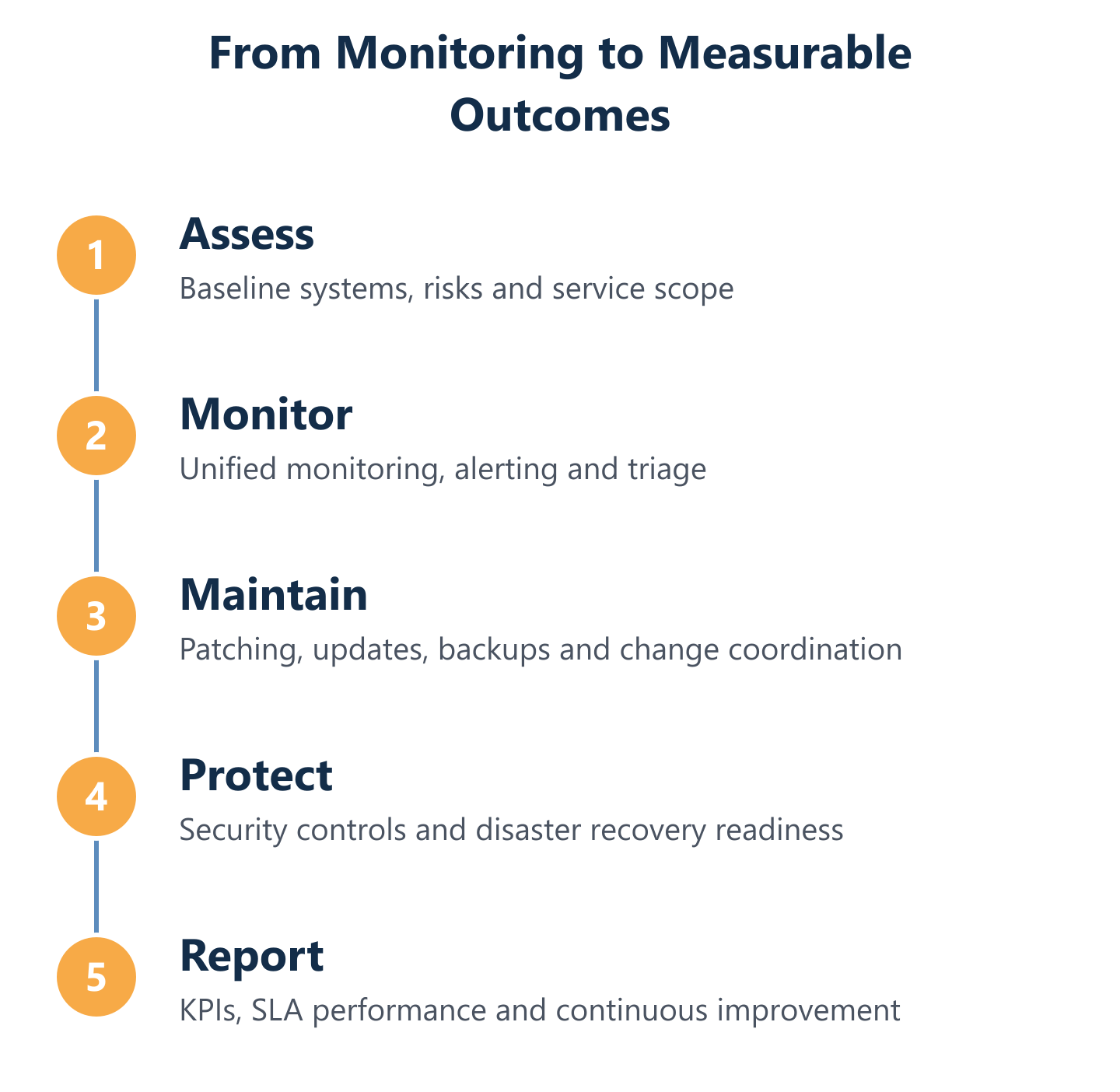
Service Capabilities by Layer (OS, Database, Network, Monitoring, NOC)
Professional IT infrastructure management is not a single service—it is a stack of capabilities, each addressing a specific technical domain. Understanding how these layers fit together helps organisations identify gaps in their current coverage and set realistic expectations when evaluating providers.Managed OS and patching: stability, updates and proactive maintenance
Operating system management is one of the highest-impact, lowest-visibility disciplines in infrastructure management. Unpatched systems are the single most common entry point for ransomware and credential theft—yet patching without a controlled process introduces its own risk: incompatible updates, service disruptions and rollback complexity.Network and connectivity management: deployment, performance and structured cabling
Monitoring and NOC/ITSM integration: alerts, triage, escalation and reporting
Monitoring without triage is noise. The value of infrastructure monitoring comes from what happens after an alert fires: how quickly it is classified, whether it triggers the right escalation path and whether the resulting ticket is tracked to resolution with full context. This is where NOC support and ITSM integration become operationally essential.
Proactive Operations, Security & Disaster Recovery Readiness (How It Works)
Reactive infrastructure management—fixing things after they break—is the most expensive operating model available. Downtime costs vary by sector, but the combination of lost productivity, emergency vendor fees and potential data loss consistently exceeds the cost of prevention. Proactive operations shift that balance by identifying degradation signals before they become failures.Proactive monitoring to root cause: predictive alerts, problem management and automation
Security, compliance and recovery: layered controls and backup/DR practices
Infrastructure security is not a single product—it is a set of overlapping controls designed so that the failure of one layer does not result in a breach. Perimeter firewalls handle traffic inspection and segmentation; endpoint protection addresses threats that reach individual devices; access controls and identity management limit lateral movement if credentials are compromised; and backup systems provide the last line of defence when prevention fails.Service governance: SLAs, escalation paths and outcome reporting for business
Service governance translates technical operations into business accountability. SLAs define the response and resolution time commitments for different incident priorities—a P1 production outage demands a different response window than a P3 software request—and create the contractual basis for holding a provider accountable. Escalation paths specify who is contacted at each tier and what triggers a move from remote to on-site support.Choosing an IT infrastructure management partner is ultimately a question of operational fit: does their service model match the environments you run, the SLAs your business requires and the security posture your risk profile demands? Start by mapping your infrastructure layers—on-premises, cloud, hybrid—against the capabilities and escalation commitments you need. Then validate with specific questions: How are patches tested before deployment? What does your DR test process look like? How is root cause tracked to resolution?BlueNova confirms service coverage across seven countries and support hours from 09:00 to 18:00 CET. Confirm the applicable contact channel and response commitments for your agreement.Frequently asked questions
What does IT infrastructure management cover end-to-end?
Typically it covers servers, operating systems, storage, network connectivity, monitoring, and operational processes like help desk, incident handling and maintenance. For hybrid setups, it also includes cloud workload operations and continuity practices.
How should monitoring coverage and incident escalation be defined?
A managed service should define monitoring coverage, alert severity levels, triage steps and escalation routes. SLAs should specify response and resolution targets, plus how incidents move between tiers.
Do you support hybrid environments and multi-cloud management?
Yes, the best approach provides consistent operational controls across on-prem and cloud. This includes unified monitoring, access governance, and coordinated maintenance and recovery across environments.
What should an infrastructure support agreement define?
Define the service scope, hours, priorities, contact channels, escalation rules and responsibilities in writing.
What security and disaster recovery capabilities are included?
Expect layered security controls, backup strategy and disaster recovery readiness aligned to your data protection needs. Reporting should show backup health, recovery testing approach and compliance-relevant evidence.