AI automation services cover the end-to-end process of identifying repetitive or data-intensive tasks in your business, designing intelligent workflows to handle them, integrating those workflows with your existing systems, and operating them reliably in production—with measurable outcomes agreed before a single line of code is written.
What AI Automation Services Include (End-to-End)
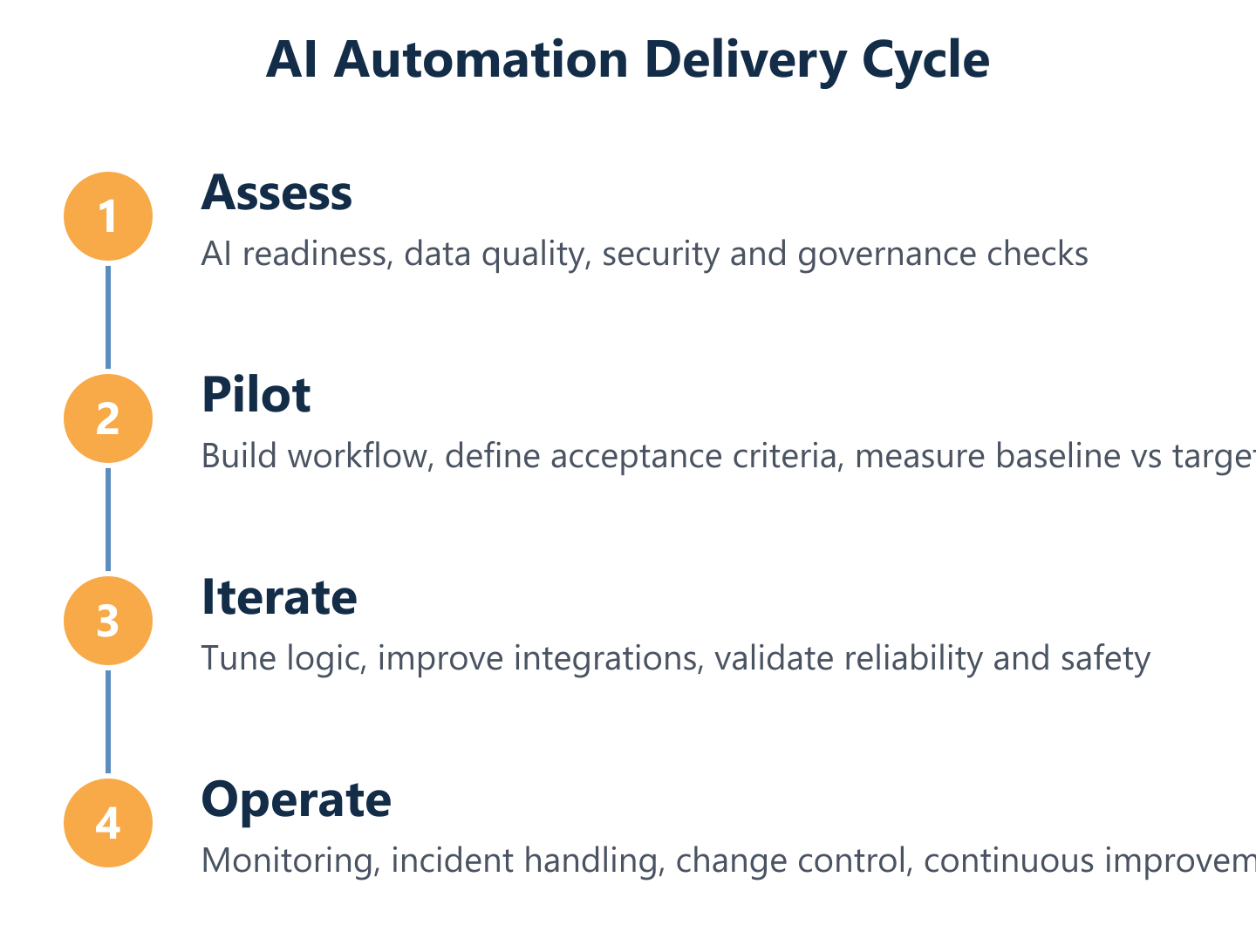
Assessment, discovery, and AI readiness checks
Before any automation tool is selected, a structured assessment identifies which processes are genuinely automatable, what data quality looks like, and whether the existing infrastructure can support the intended workflows. This is not a formality—it is the step that determines whether a project will deliver ROI or simply add technical debt. A proper AI readiness check covers process documentation (are the steps consistent enough to automate?), data availability and cleanliness (does the system have reliable inputs?), integration feasibility (can the relevant platforms be connected securely?), and governance requirements (who approves automated decisions, and how are exceptions handled?). Skipping this phase is the single most common reason automation projects are rebuilt within 12 months.Pilot build, acceptance criteria, and iteration plan
Operational handover: monitoring, support, and change control

Choosing the Right Approach: No-Code, Code-Based, or Hybrid
The debate between no-code, low-code, and custom-coded automation is not a question of which is technically superior—it is a question of fit. The right approach depends on the complexity of the process, the security requirements of the data involved, the maintenance capacity of your team, and the time-to-value you need. Getting this decision wrong is expensive: organisations that over-engineer simple workflows waste budget, while those that under-engineer complex ones face brittle systems that break whenever an API changes.Decision criteria: complexity, security, and long-term maintenance
Tooling fit: workflow automation platforms and integration layers
Pros and cons by approach: speed vs control vs total cost
Measuring ROI and Managing Risk: Governance, Security, and Success Metrics
Automation ROI measurement fails when the baseline is not recorded before the project starts. The most common mistake is agreeing on metrics after deployment, at which point the pre-automation state is either forgotten or estimated. A reliable ROI framework requires three things: a documented baseline (current time spent, error rate, throughput, or cost per transaction), agreed targets for each metric, and a reporting cadence that makes performance visible to both technical and business stakeholders.ROI metrics that buyers can agree on: baseline, targets, and reporting cadence
Governance and responsible AI: avoid black-box behaviour and enforce controls
Risk management in production: monitoring, incident response, and continuous tuning
BlueNova confirms service coverage across seven countries and support hours from 09:00 to 18:00 CET. Confirm the applicable contact channel and response commitments for your agreement.Frequently asked questions
What is the best first step before building AI automation in my business?
Start with an AI readiness assessment to confirm data quality, integration feasibility, and governance requirements. Then define 1–2 high-impact workflows for a pilot with clear success metrics.
Do you start with a pilot or go straight into implementation?
Most organisations should begin with a pilot to validate assumptions, acceptance criteria, and ROI baselines. Full implementation follows once the workflow is reliable, secure, and measurable.
How do you measure ROI for AI automation services?
Agree on a baseline and track metrics such as time saved, throughput, reduced overhead, error rates, and revenue or pipeline impact. Report on a fixed cadence with transparent methodology.
What’s the difference between project-based delivery and a retainer?
Project delivery focuses on a defined scope and timeline (e.g., pilot and production release). A retainer supports ongoing optimisation, new automations, monitoring, and continuous governance.
Does an AI automation project require an in-house technical team?
At minimum, name business owners and data owners. Integrations, access and ongoing maintenance also need clear ownership.