Cybersecurity services are structured programmes that protect an organisation's systems, data, and operations through a combination of monitoring, threat detection, vulnerability management, access controls, and incident response — delivered by specialists who treat security as a continuous operational discipline, not a one-time project.
Most organisations face the same underlying problem: security tools get deployed, but without the processes, expertise, and accountability to run them effectively, gaps remain invisible until something goes wrong. A firewall that isn't monitored, an endpoint agent that isn't tuned, or an access policy that hasn't been reviewed in two years — these are the conditions that turn a minor misconfiguration into a reportable breach.
What "Cybersecurity Services" Cover (and why they matter)
Cybersecurity services span a broad operational scope: they protect people, systems, data, and processes from threats that range from opportunistic malware to targeted intrusions and insider risk. The business outcomes they map to are concrete — reduced likelihood of a breach, faster recovery when incidents do occur, and a defensible compliance posture when regulators or auditors ask questions.| Business Outcome | Relevant Service Area | Key Metric or Deliverable |
|---|---|---|
| Reduced breach likelihood | Vulnerability management, access controls, endpoint protection | Patch coverage rate, open critical vulnerabilities |
| Faster incident containment | Managed detection & response, SOC, EDR | Mean time to detect (MTTD), mean time to respond (MTTR) |
| Operational resilience | Backup, disaster recovery preparation, continuity planning | Recovery time objective (RTO), recovery point objective (RPO) |
| Compliance readiness | GRC, policy development, audit support | Control coverage against framework (e.g., ISO 27001, NIS2, GDPR) |
| Attack surface reduction | External risk management, penetration testing, access hardening | Number of exposed assets, remediation completion rate |
A practical definition of Cybersecurity Services
Security delivery is operational when it moves beyond configuration and into continuous activity: monitoring systems for anomalies, investigating alerts to determine whether they represent genuine threats, responding to confirmed incidents with defined containment steps, and feeding findings back into an improvement cycle. A practical definition of cybersecurity services, therefore, is not a list of tools — it is a structured set of workflows, responsibilities, and outputs that keep an organisation's risk posture under active management. This includes both reactive capabilities (incident response, forensic investigation) and proactive ones (vulnerability scanning, threat hunting, access reviews), operating together within a defined governance structure that makes accountability clear and measurable.Common service categories and typical outputs
Cybersecurity services are commonly grouped across three dimensions: people, process, and technology. On the technology side, this means endpoint detection and response (EDR), firewalls, SIEM platforms, and identity management tools. On the process side, it means incident response plans, vulnerability management cycles, penetration testing schedules, and access review procedures. On the people side, it means analysts, consultants, and governance specialists who operate these capabilities and translate findings into action. Typical outputs from a mature programme include vulnerability reports with prioritised remediation lists, incident reports with root cause analysis, access audit findings, compliance gap assessments, and security posture dashboards that give leadership a clear view of where risk sits at any given time.Pros and cons of tool-only vs managed security delivery
Core Service Types: What you should buy (and what you get)
Five service types form the foundation of most cybersecurity programmes. Understanding what each one does — and what it actually produces — helps organisations avoid buying capabilities they cannot operationalise or skipping protections that address their highest-probability risks.External risk management: scope, signals, and remediation actions
Incident response and penetration testing: goals, evidence handling, and outcomes
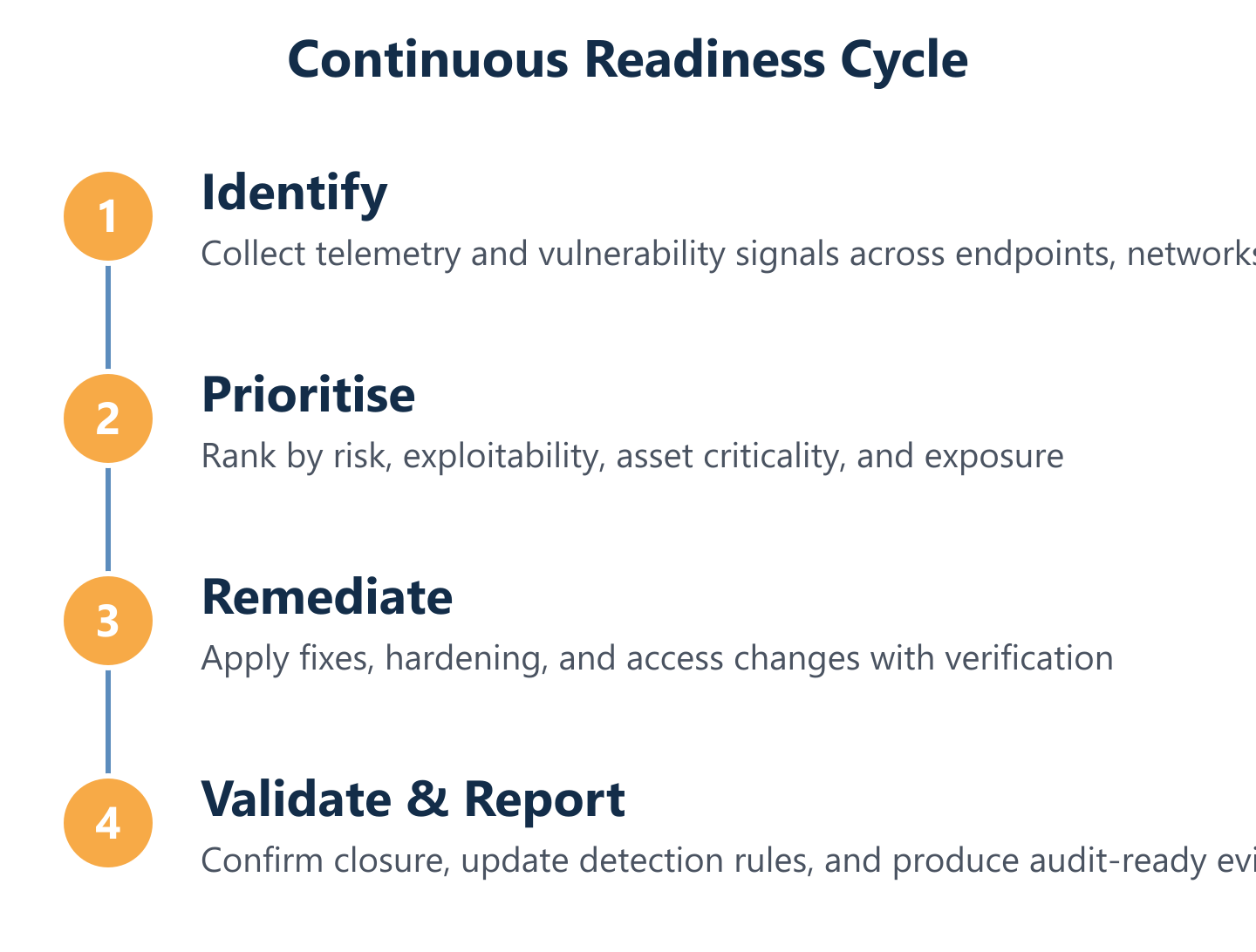
Vulnerability management and access management: continuous cycle and hardening deliverables

Managed Detection & Response and Continuous Readiness
Managed detection and response (MDR) represents the operational core of a mature cybersecurity programme — the capability that ensures threats are not just technically detectable but are actually investigated and acted upon within defined timeframes. Continuous readiness extends this by linking detection and response to an ongoing vulnerability lifecycle and compliance reporting cycle, so that security posture improves over time rather than degrading between assessments.- Continuous monitoring across endpoints, network traffic, identity events, and cloud workloads, with alert triage performed by trained analysts rather than left to automated rules alone.
- Defined investigation workflows that move from initial alert through contextual enrichment, threat classification, and escalation decisions within documented timeframes.
- Structured incident response procedures with clear containment, eradication, and recovery steps that are rehearsed before they are needed.
- Vulnerability lifecycle management that tracks open findings from discovery through remediation verification, with reporting that shows trend improvement over time.
- Compliance alignment — mapping security controls to frameworks such as GDPR, ISO 27001, or NIS2 so that audit evidence is generated as a by-product of operational activity, not assembled at the last minute.
How a 24/7 SOC typically delivers detection, investigation, and response
SIEM/SOAR, IDS, and EDR: what each component contributes
These three components address different layers of the detection and response stack, and their value multiplies when they operate together. A SIEM (Security Information and Event Management) platform aggregates and correlates log data from across the environment — servers, firewalls, identity providers, cloud services — enabling analysts to spot patterns that no single source would reveal. SOAR (Security Orchestration, Automation and Response) adds automated playbooks that handle repetitive triage tasks and enforce consistent response actions, reducing analyst workload and mean time to respond. IDS (Intrusion Detection Systems) monitors network traffic for signatures and behavioural anomalies at the network layer, providing visibility into lateral movement and command-and-control communications. EDR (Endpoint Detection and Response) operates at the device level, recording process execution, file system changes, and network connections to enable both real-time detection and retrospective investigation. Together, these components provide the telemetry depth and automation capacity that makes fast, consistent triage achievable at scale.Continuous readiness: vulnerability lifecycle, reporting, and audit support
BlueNova confirms service coverage across seven countries and support hours from 09:00 to 18:00 CET. Confirm the applicable contact channel and response commitments for your agreement.Frequently asked questions
Which cybersecurity steps should come first when security gaps are unknown?
Inventory critical assets, review access, check patching and backups, then assess incident-response readiness.
What can continuous security monitoring include?
Depending on the agreed scope, it can include log collection, alert triage, investigation and an escalation process. Confirm hours and responsibilities in writing.
How do vulnerability management and penetration testing differ, and how often should each be performed?
Vulnerability management is continuous: identify, prioritise, remediate, and verify fixes. Penetration testing is periodic and risk-based, focusing on validating exploitability and improving controls.
Can a provider guarantee compliance?
Compliance depends on the organisation’s obligations and actual operations. A provider can contribute controls and evidence, but any compliance claim must be checked in context.
Do you provide access management improvements like MFA/SSO, and how do you assess least-privilege access?
Access management improvements typically include MFA/SSO rollout and role-based access reviews. Least-privilege is assessed by analysing identities, permissions, and privileged access paths, then tightening entitlements.